What Is the 3 6 9 Rule in Dating and Texting? (Real Answer)
What is the 3 6 9 Rule in Dating and Texting? (When Silence Actually Tells You Everything)
You’re staring at your phone. Two months ago, he was double-texting you, sending good morning paragraphs, and replying within seconds. Now? You’re lucky to get a “sounds good” four hours later.
You start panicking. You run through every possible reason. You’re probably wondering if you said something wrong, came on too strong, or if there’s someone else.
Here’s the pattern break most people miss: late replies don’t always mean disinterest. Sometimes, it’s the exact opposite.
If you’ve been searching for answers, you’ve probably come across the question — what is the 3 6 9 rule in dating and texting? The honest answer is that there isn’t just one version of this rule. There are at least four. And understanding which one actually applies to your situation is the difference between overreacting and seeing things clearly.
So What Is the 3 6 9 Rule in Dating and Texting Really About?
- The texting timing version: Wait 3 minutes before replying to a casual text, 6 minutes for something flirty, and 9 minutes if you want to build a little tension without seeming desperate.
- The relationship timeline version: The 3, 6, and 9-month marks each represent a real psychological shift in how two people communicate — and what that communication actually means.
- The rhythm version: 3 days of warm, consistent contact — then a natural pull-back for 6 days — then a reset and reconnection at day 9.
- The interest-testing version: Send 3 messages with no response before going quiet. Wait 6 days. Try one final time at day 9. If still nothing — you have your answer.
Each version has a different purpose. The timeline version is the one most people don’t know about — and it’s the most useful one for understanding why someone’s texting behavior shifts over time.
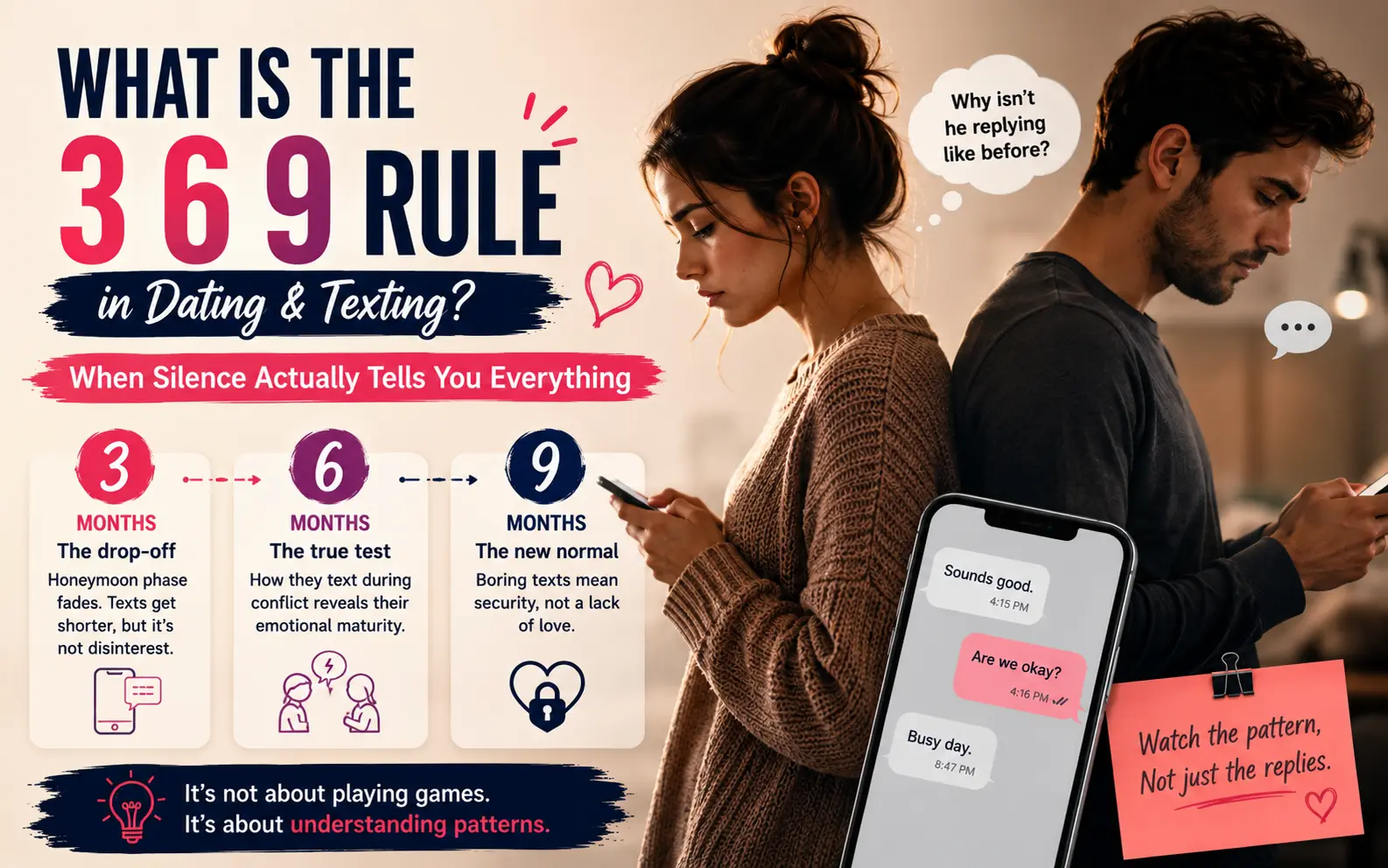
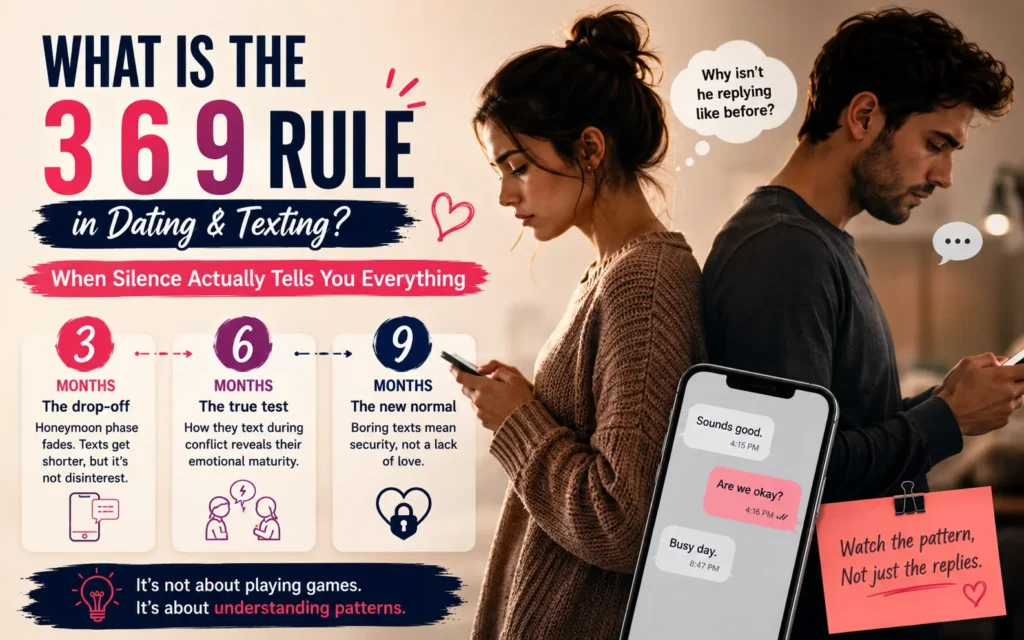
Month 3: The Texting Drop-Off (And Why It’s Not What You Think)
At the very beginning, texting is a tool for seduction. They are matching your energy, using emojis, keeping the banter rapid-fire. Every reply feels intentional and exciting.
But right around the 90-day mark, the honeymoon haze starts to clear. Research suggests the initial dopamine rush levels out. This is when I see the most panic.
Suddenly the texts get shorter. Response times stretch from minutes to hours. The good morning paragraphs disappear.
What You Think vs. What It Actually Means:
- What you think: He’s losing interest, talking to someone else, or gearing up for a disappearing act.
- What it actually means: He is finally comfortable enough to put his phone down and live his life without fearing you’ll vanish the moment he does.
This happens more often than people admit. The performative version of them — the one designed to impress you — starts to relax. If you demand day-one texting energy at month three, you might accidentally push away someone who is actually getting more attached, not less.
Month 6: The Silent Treatment vs. Real Communication
By month six, you aren’t just dating anymore. You are figuring out each other’s emotional patterns. This is the conflict stage — and how someone texts you when they’re upset tells you more about your future together than almost anything else.
Do they pull away and go silent for twelve hours? Or do they communicate their need for space?
The bad 6-month texting pattern:
You: “Are we okay? You’ve been quiet all day.”
Them: “I’m fine.” (Followed by 12 hours of radio silence.)
The healthy 6-month texting pattern:
You: “Are we okay? You’ve been quiet all day.”
Them: “Just overwhelmed with work and need a minute to decompress. I’ll call you tonight.”
The difference between those two responses is everything. One is stonewalling. The other is emotional maturity. If their texting during disagreements feels deliberately cold or punishing, pay close attention — this pattern almost never improves on its own.
Around this milestone, running through a Dating Red Flags Quiz can help you separate normal relationship friction from genuinely unhealthy communication patterns before you’re in too deep.
Month 9: When Boring Texts Actually Mean You’ve Won
If you make it to nine months, texting fundamentally changes its purpose. It is no longer about proving affection or keeping the spark alive through a screen. It becomes a practical, logistical tool.
You might go an entire workday without a single message, and it shouldn’t trigger anxiety. The texts shift from “I miss you so much, what are you doing?” to “Can you grab oat milk on the way over?”
At first glance, it looks like the romance is fading. But I’ve noticed this pattern in almost every successful long-term couple. The silence isn’t empty. It’s secure.
This is very similar to how guys act when they pull away after intimacy — they often just need space to regulate their own routines, not because they care less. They stop trying to impress you with words and start showing up with consistent, everyday actions. That shift is worth more than any good morning text.
The Texting Timing Version — What It’s Actually Doing
The “wait 3, 6, or 9 minutes before replying” version of this rule gets the most attention online — and it’s the most misunderstood.
I’ve noticed this pattern more times than I can count. Someone gets a message they’re genuinely excited about and replies within eight seconds. Not because they’re confident — because they’re anxious and acting on pure impulse. The problem isn’t the speed. It’s that a near-instant reply in the early stages often reads like you’ve been sitting there, phone in hand, waiting.
The pause isn’t about playing games. It’s about giving yourself a moment to breathe, reread what they sent, and reply from a calm place instead of a reactive one.
I might be wrong about this — but I genuinely think what you say matters far more than when you say it. A slow reply to a boring message still lands flat. A warm, funny reply sent 30 seconds later still works.
The Quality vs. Quantity Test Nobody Talks About
Here’s the one detail most people completely miss while obsessing over response times.
If he takes five hours to reply but sends a thoughtful response to something you said — you’re fine. The relationship is maturing.
If he takes five hours to reply and just sends “lol” or “yeah” — the connection is actively fading. The 3 6 9 rule in dating and texting is not an excuse for low-effort behavior. It’s simply a lens for understanding natural transitions.
Watch for these small signs people consistently ignore:
- Their reply length vs. yours. Sending paragraphs and getting back three words is a mismatch that matters more than any timer.
- Who initiates vs. who only responds. The rule says nothing about this — but it tells you almost everything about where the interest actually lives.
- Whether they remember details. Someone who replies slowly but references something you said two days ago is paying attention. Someone who replies fast but asks questions you’ve already answered isn’t.
- Energy after a deliberate pause. If calculated delays keep breaking the natural warmth of a conversation, you might be creating distance instead of tension.
The Interest-Testing Version — Harsh, But Sometimes Honest
Three unreturned messages is usually enough information. Most people already know this. They just don’t want to act on it yet.
The “3 texts, wait 6 days, one final attempt at day 9” framework isn’t really about giving the other person more chances. It’s about giving yourself a structured way to stop. It builds in patience so you don’t send a desperate fourth message. And it builds in closure so you don’t cut someone off the moment they have one genuinely busy week.
There’s something almost kind about having that structure. Not romantic — just practical.
The TikTok Myth — Let’s Be Honest About This
We can’t talk about this topic without addressing the version that floods social media. Influencers claim that writing a person’s name 3 times, your intention 6 times, and the outcome 9 times will magically make them text you back.
Here’s my slightly unpopular personal opinion. A positive mindset genuinely helps in dating — but no amount of writing on a piece of paper fixes a fundamentally misaligned connection. If you are sitting at a desk trying to manifest a text back from someone giving you radio silence, you are pouring energy into the wrong place.
Use the pause. Don’t become the pause. And definitely don’t replace action with a manifestation ritual.
What To Do Next
- Stop counting minutes once you pass the three-month mark. Expect the drop-off in texting frequency and welcome it as a sign of real comfort setting in.
- Pay close attention to how they text during your first real disagreement. Stonewalling or passive-aggressive one-word replies around month six is a pattern, not a phase.
- Watch quality over quantity. A thoughtful slow reply beats a meaningless fast one every time.
- If three messages go unanswered, go quiet. Wait 6 days. One final message at day 9. Then you have your answer and your peace.
- If the texts are boring but they show up consistently in person, you are winning. Logistics texts at month nine are a relationship milestone, not a red flag.
Most people don’t lose relationships because of texting timing. They lose them because they misunderstand what the silence actually means.
FAQ
Why did he suddenly stop texting me as much after 3 months?
If communication slowed down but you’re still seeing each other regularly, it’s almost always the honeymoon phase ending not interest fading. A complete stop with zero contact is different. That’s not the 3 6 9 rule. That’s a disappearing act.
Is the 3 6 9 texting timing rule manipulative?
It can be, if you’re using deliberate delays to control how someone feels. Used to calm your own anxiety before replying it’s harmless and actually useful. The difference is whether you’re regulating yourself or performing for someone else.
Is it bad if we still text constantly at 9 months?
Not at all. Some couples are naturally heavy texters. As long as the constant contact isn’t driven by anxiety or a need for constant reassurance, enjoy the connection. The goal isn’t less texting it’s texting that comes from a secure place rather than a fearful one.
Meta Description: Wondering why his texts suddenly changed? The 3 6 9 rule in dating and texting explained — what it really means at 3, 6, and 9 months.